

In September, I published a guide about the Heroku Developer Architect Professional certificate exam, where I shared helpful materials and described my experience and what you can expect from it.
Just a few weeks ago, I also passed a new Heroku Architect exam, another prerequisite for the new partnership program Salesforce announced earlier this year.
In this post, I’d like to share my experience and highlight the differences between the two certifications.
It will be a shorter one.
I don’t have much to share because a lot of the materials from the previous post are still helpful for this one.
Here is a short list of the most helpful links:
About the Heroku Architect Certification
As the name suggests, the most significant difference is that this exam focuses on architecting applications rather than a hands-on experience with Heroku.
Consider the Heroku Architect exam a test of your ability to design and evaluate system trade-offs, such as choosing the appropriate architecture or data service for different requirements.
In contrast, the Developer exam assesses your proficiency with practical implementations.
Again, there aren't many resources available online about this certification, and as I understand it, it’s relatively new because it seems different from the previous Heroku Architecture Designer certification.
However, I still want to highlight a few other posts that I find helpful:
- https://quirkyapex.com/2019/11/16/my-experience-with-passing-the-heroku-architect-designer-exam/
- It includes a few videos on event-driven architecture and Kafka, with a demo, as well as a short dive-in session into the exam.
- https://paulbattisson.com/blog/2019/passing-the-heroku-architecture-designer-certification/
- I can definitely relate to Paul about the Heroku Enterprise, because even though I used the platform before, I also lacked experience with the enterprise features.
Once again, the Heroku Dev Center is your best friend here.
Data Services
Generally, most of the questions were scenario-based.
In practice, it means you need to know the Heroku-managed data services well, such as Heroku Postgres, Data Clips, Heroku Key-Value Store, Heroku Apache Kafka, and Heroku Connect.
You can learn more on the topic here.
For example, based on the given scenario, you need to choose whether to use Redis or Apache Kafka for job scheduling.
The decision depends on the requirements, whether you need to prioritize simplicity and speed or durability and scalability.
There were plenty of questions about Heroku Connect, so make sure you’re familiar with it and such areas as what type of data can be synced, how you can support multiple organizations, how many records you can sync, what the supported object relationships are, and how Heroku Connect processes the insertion, etc.
Here is a helpful resource on handling object relationships: Handling object relationships in Heroku Connect.
Network
There were plenty of questions about the network connections.
As an architect, you need to understand how network communication works in Heroku.
For example, how can you communicate between the private spaces?
How to connect to AWS, GCP, Azure, and VPN?
How does the Heroku load balancer work?
Here is a helpful section from the documentation: Infrastructure Networking
Heroku Enterprise
A significant portion of the exam focuses on Heroku Enterprise.
I don’t recall seeing it during my exam, but I’d expected questions about the accounts and teams in Heroku, as well as simple things like setting up SSO and how it works.
The exam included many scenarios in which you were expected to suggest a networking solution that met the compliance requirements.
So, make sure you know the compliance differences between Common Runtime, Private, and Shield.
I will put the helpful image from the Heroku docs here again.
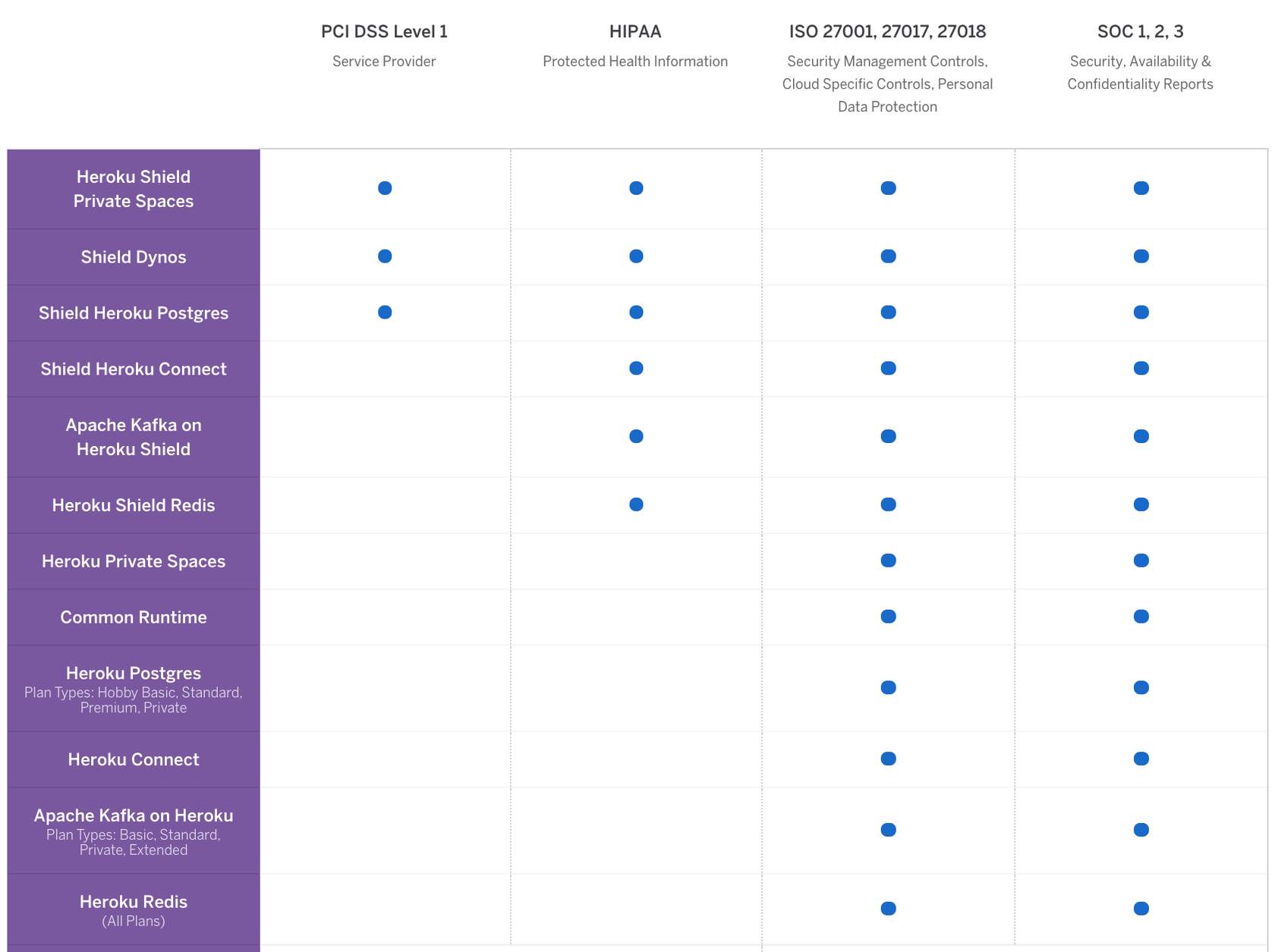
The questions could ask you to suggest the architecture for a payment-processing app or an application that handles personal medical data.
For example, note that PCI DSS Level 1 compliance is supported only in Shield Heroku Postgres, but not in the other data services.
Otherwise, you also need to understand the GDPR compliance of both Heroku and its add-ons, as well as understand the logging options.
The rest of the sections
Definitely familiarize yourself with the Twelve-Factor App Manifest, as it is a cornerstone of the Heroku architecture, and there were direct questions about it.
For example, how would you architect the application for a given situation according to that manifest?
I will share here the list one more time:
- I. Codebase
- One codebase tracked in revision control, many deploys
- II. Dependencies
- Explicitly declare and isolate dependencies
- III. Config
- Store config in the environment
- IV. Backing services
- Treat backing services as attached resources
- V. Build, release, run
- Strictly separate build and run stages
- VI. Processes
- Execute the app as one or more stateless processes
- VII. Port binding
- Export services via port binding
- VIII. Concurrency
- Scale out via the process model
- IX. Disposability
- Maximize robustness with fast startup and graceful shutdown
- X. Dev/prod parity
- Keep development, staging, and production as similar as possible
- XI. Logs
- Treat logs as event streams
- XII. Admin processes
- Run admin/management tasks as one-off processes
Otherwise, you can also find it on the manifest website.
Conclusion
Overall, the exam shouldn’t be a problem if you’re familiar with all the listed sections and preferably have prior experience with Heroku or other cloud architectures.
However, it definitely doesn’t mean that the exam is easy.
The exam covers many of the same topics as the accredited developer certification, but I don’t recall any questions about SSL, CI, or the Heroku Pipeline.
Most of the questions are based on scenarios where you need to suggest the correct runtime, data services, security architecture, and integration strategy based on the given requirements.
This post will help you get a glimpse of what you can expect from the exam so that you can prepare better.
I wish everyone who is attempting to obtain this certification good luck!

Nikita Verkhoshintcev
Senior Salesforce Technical Architect & Developer
I'm a senior Salesforce technical architect and developer, specializing in Experience Cloud, managed packages, and custom implementations with AWS and Heroku. I have extensive front-end engineering experience and have worked as an independent contractor since 2016. My goal is to build highly interactive, efficient, and reliable systems within the Salesforce platform. Typically, companies contact me when a complex implementation is required. I'm always open to collaboration, so please don't hesitate to reach out!

